
The former Chief of Army Staff said India faces the most complex threats and challenges spanning a full spectrum of possible conflict -- from nuclear to sub-conventional -- but asserted that the armed forces are ready to deal with them.

"We will remember the soldiers' families, loved ones, and communities as they grieve," said Pompeo.
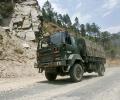
It is learnt that Defence Minister Rajnath Singh has conveyed to top military brass that there was no need for reviewing the implementation of any of the key projects along the Line of Actual Control (LAC) in Ladakh, Sikkim, Uttarakhand or in Arunachal Pradesh in view of the aggressive behaviour by Chinese troops in several sensitive areas.
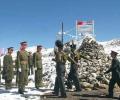
People familiar with the situation in the region said the two sides were engaged in trying to resolve the dispute, but there was no indication of a positive outcome yet as both the armies continued to bolster their positions in disputed areas of Pangong Tso and Galwan Valley and Demchok.

Nearly two decades ago, then defence minister George Fernandes said: 'China has built roads up to the border, while there has been negligence on India's part.' Since Fernandes uttered these brave words, what has been done on the Indian side? The Modi Sarkar is apparently trying, but little has been achieved so far, says Claude Arpi.
While the de-escalation process was underway, a violent face-off took place on Monday night between Indian and Chinese troops leading to the death of 20 Indian soldiers.
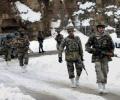
Within the army, there is growing concern that New Delhi will allow the Chinese to retain the territory they have occupied in the last month.

Chinese foreign ministry spokesman Geng Shuang told a media briefing in Beijing that "at the moment the situation in the boundary region between China and India is overall stable and controllable".

The Standing Committee on Water Resources has recommended renegotiating the Indus Water Treaty with Pakistan to address the impact of climate change on water availability in the river basin and other challenges which are not covered under the agreement.
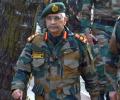
The commanders will also deliberate on the overall situation in Jammu and Kashmir besides delving into issues having national security implications, they said. However, the main focus will be on the situation in eastern Ladakh where Indian and Chinese troops are locked in an eyeball-to-eyeball face-off in Pangong Tso, Galwan Valley, Demchok and Daulat Beg Oldie, the sources said.
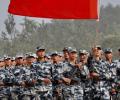
The Chinese action followed 'India's recent, illegal construction of defence facilities across the border into Chinese territory in the Galwan Valley region', a write-up in the state-run Global Times tabloid said, quoting unnamed military sources.
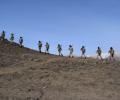
On May 5, around 250 Indian and Chinese army personnel clashed with iron rods, sticks, and even resorted to stone-pelting in Pangong Tso lake area in Eastern Ladakh.

'It is a pattern of behaviour of the Chinese that whenever a Chinese leader visits India or an Indian leader visits China, some incidents take place.' 'When Modi visits China, we should look out for some similar demonstration by the Chinese.'

Referring to allegations that it was "silly for China" not to have names for various counties and inventing them for six places in Arunachal Pradesh, an op-ed article in the state-run Global Times said "these comments are absurd".
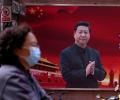
China has not limited the 'battle' to the diplomatic field alone; the People's Liberation Army has become aggressive on the ground too. The recent 'fights' in Northern Sikkim and Ladakh are part of the pattern, asserts Claude Arpi.

Seismologists point out that northeast India is prone to earthquakes similar to the one that hit Sikkim , other parts of India, Nepal and Tibet on Sunday evening. K Anurag reports

India has over 4,000 medium tanks, but not a single light tank. It remains to be seen whether the Ladakh face-off with China galvanises a change, observes Ajai Shukla.
'The Chinese have been moving in step by step; inch by inch for the last 40 years.'
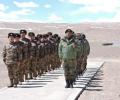
The US hopes that the differences will be resolved peacefully, officials said in Washington.
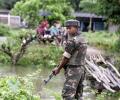
'Our boys are very patriotic.' 'They say Bharat Mata Ki Jai and Jai Hind in front of the Chinese.' 'We have never accepted their claims, we are Indians and proud to be Indians.'
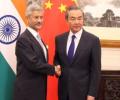
Wang said the two sides should follow the important consensus reached by the leaders of the two countries and strengthen the communication and coordination on the proper handling of the border situation through the existing channels so as to jointly maintain peace and tranquility in the border area, the Chinese foreign ministry said in a statement.

China has long coveted Arunachal Pradesh, which it calls Southern Tibet. But, as Venkataraghavan Subha Srinivasan explains, in 1947, the present state of Arunachal Pradesh constituted the North East Frontier Tract of Assam. When India adopted its Constitution on 26 January 1950, NEFT became 'a separate politico-administrative entity' although it was constitutionally still a part of Assam. Its administration was brought directly under the President of India with the Governor of Assam acting as his agent. A revealing excerpt from his book The Origin Story of India's States.
Gitanjali Bakshi, who recently authored a report titled 'The Indus Equation' for the Strategic Foresight Group, states that water shortage problems in Pakistan are not a case of obstruction by external forces but rather a case of wastage and unequal distribution by internal forces.
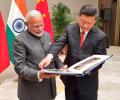
'In South Asia, unlike Southeast, East, or Central Asia, there is a natural hegemon: India. China cannot cast it aside easily'

'You have been surrounded from all directions, if you want the safety of your troops and your personal safety, we will give you eight hours to make up your mind to surrender.'

He termed the situation with China as 'very dangerous' and said India under Modi does not have any clear cut strategy on China, which is testing the country and will not sit silent.
On December 10, Kissinger began to encourage the Chinese to take action against India: 'If the People's Republic were to consider the situation on the Indian subcontinent a threat to security, and if it took measures to protect its security, the US would oppose efforts of others to interfere with the People's Republic.' On the 50th anniversary of India's greatest military victory, Claude Arpi recalls how the US suggested that China intervene militarily on Pakistan's side.
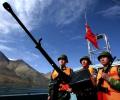
"As far as I know, China presently has not detained any Indian personnel," Chinese foreign ministry spokesman told a media briefing in Beijing while answering questions on the tense standoff between the Indian and Chinese troops at the Galwan Valley.

With the two armies again in a face-off at multiple points, there is apprehension of renewed clashes.
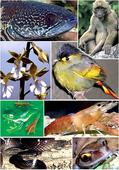
A new report compiled by the WWF titled 'Eastern Himalayas -- Where the Worlds Collide' mentions the discovery 244 plants, 16 amphibians, 16 reptiles, 14 fish, 2 birds, 2 mammals and at least 60 new invertebrates.

India on Wednesday delivered a strong message to China that the 'unprecedented' incident in the Galwan Valley will have a 'serious impact' on the bilateral relationship and held the 'pre-meditated' action by Chinese army directly responsible for the violence that left 20 Indian Army personnel dead.
The Chinese side has particularly bolstered its presence in the Galwan Valley, erecting around 100 tents in the last two weeks and bringing in heavy equipment for construction of bunkers, notwithstanding the stiff protest by Indian troops. There have been reports of multiple incidents of transgressions by Chinese troops in several areas in Eastern Ladakh.

The fighter plane has been untraceable since Tuesday.
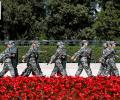
China on Friday hiked its defence budget to $209 billion, maintaining a single-digit growth for the sixth consecutive year with a 6.8 per cent increase in 2021.
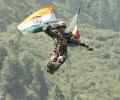
So far, the Central Sector has never seen active hostilities, remaining peaceful even through the 1962 war. A reason for the Central Sector having remained peaceful is the towering Himalayan watershed that defines the border.

'All PoWs recounted that one of the worst aspects of their captivity in Tibet was the constant attempt at brainwashing by Chinese Communist propaganda,' reveals Claude Arpi.

Through the past 18-month period, peace has prevailed in the disputed border regions, which was immensely helpful in the difficult situation that the country was passing through, observes Ambassador M K Bhadrakumar.

'Does the Indian army's new assertiveness risk a clash escalating into shooting and possibly skirmishes?' asks Ajai Shukla.
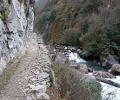
'It is certainly time for New Delhi to open up. Not only should it go ahead at full steam with the roads to the LAC, but the government must also allow tourists to visit these stunningly beautiful areas of Indian territory.'

China on Wednesday warned that it will take "necessary measures" to defend its territorial sovereignty and interests after India "obstinately" allowed the Dalai Lama to visit the "disputed" parts of Arunachal Pradesh causing "serious damage" to the bilateral ties.
 © 2026 Rediff.com - Advertise with us - Disclaimer - Privacy Policy - Sitemap - Feedback - About us - Terms of use - Grievances